Energy management
Our energy management strategy has four objectives:
- Energy efficiency first – prioritising the lowest-cost, highest-impact interventions
- Maximising self-generation, storage and direct supply – reducing grid dependency and improving energy resilience
- Minimising costs
- Building supply resilience to ensure we can deliver our services
Energy remains one of our largest operational inputs, with total consumption of 1058 GWh in 2025/26. We continually monitor our consumption, generation and export of energy and publish annual records in the Energy and Carbon report within the UU Group Integrated annual report, the most recent of which is available here. We also calculate intensity measures such as the energy consumption per ML of water produced and distributed.
A growing population and increasingly stringent environmental performance expectations are driving up our energy use, reinforcing the need to improve efficiency and reduce our operational impact. Since 2022, the long-term incentive plans (LTP) for senior leaders and directors have included a carbon measure. Each LTP covers three years and two of those currently active directly relate to consumption and emission intensity of energy.
- LTP 2024 reduction of fuel-related GHG emissions measures in year 2026/27
- LTP 2025 percentage of energy used from low-carbon sources in year 2027/28.
Renewable energy generated and low carbon alternatives met 24.1% of our energy need in 2025/26. Most of our generation was from combined heat and power (CHP) engines converting biogas from our sludge treatment processes into low-carbon power. We also use biogas in place of natural gas in boilers and in Davyhulme export some of it through a gas-to-grid connection.
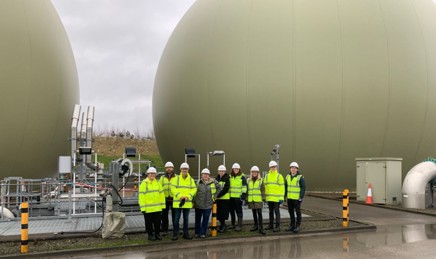
We’re continuing to build on this. We’ve developed a regional plan and identified ways to improve how we generate and use biogas – from boosting digestion performance, to increasing the efficiency of our CHP engines, to scaling up innovative carbon capture technology that converts biogas into hydrogen and graphene.
Alongside this, we’re making more switches to low‑carbon fuels. Last year, we replaced 21% of the mineral diesel used in our generators and vehicles with sustainably sourced hydrotreated vegetable oil (HVO), avoiding over 3,100 tonnes of carbon emissions. HVO is a key step on our journey, helping us reduce emissions now as we move towards electrifying suitable assets by 2040.
Together, these changes are helping us cut carbon while building a more resilient, future‑ready operation.