26 Jun 2026
Environmental improvements planned across Cumbria
We’ve got plans to deliver long-term environmental benefits to reservoirs, tarns and weirs across Cumbria.
Haweswater and Blea Water
You may have heard of Haweswater - an iconic reservoir in the Lake District which supplies two million customers with high-quality drinking water. But have you heard of Blea Water? Blea Water is a tarn of special scientific interest, just up from Haweswater, but unlike its neighbour is no longer used as a source of water supply.
It’s at these two sites where we have plans to deliver long-term environmental benefits, which would:
- Remove barriers to fish movement
- Restore natural flows and sediment transportation
- Improve river habitat quality
- Create more resilient and diverse woodlands
Our plans for Blea Water
We’re planning to remove some old infrastructure including a disused weir and pipework. This kit was important up until 2014 where the tarn was used for drinking water, but by removing the equipment we’re going to bring lots of benefits to nature. We’ll remove barriers to fish, improve river habitat quality, and restore natural flow and sediment transportation.
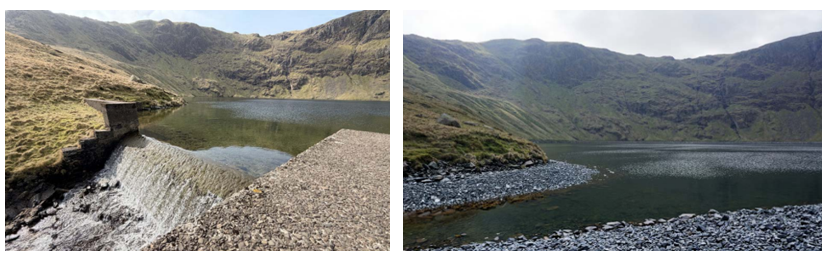
Blea Water before (left) and after our work (right)
Our plans for Haweswater
At Haweswater we’re planning to replace 15 hectares of aging conifers. These were planted around 70 years ago and are at increasing risk of being blow over due to exposed location and thin soil. The trees represent a safety risk for users of the forest and pose risks to the water quality in the reservoir. We’ll be replacing the trees with native species including oak, rowan and birch. These are all better suited to landscape conditions and more resilient to the wind.
Being in the depths of the Lake District, the remote locations of these bodies of water makes the construction work challenging. There will be some road closures and diversions in place throughout our work – you can see the full details of our plans here.
What happens next?
We're working with a range of partners, stakeholders and engaging with specialist ecological contractors to carry out surveys and assessments this summer which will help us to inform the design and develop the planning application.
More than 100 customers have also shared their views at drop-in sessions. This feedback will be incorporated into the planning application process and we’ll be holding more sessions as our plans develop.
Yearl Weir
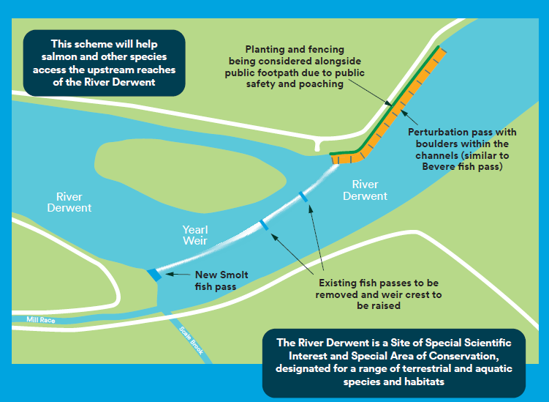 For our next improvement project we’re going over to Workington. Yearl Weir is located close to the mouth of the River Derwent. The weir, which in some form dates back to the 18th century, is used to support the abstraction of non-drinking water for the use of industry nearby.
However, like many historic features of our river system, the construction limits the movement (up and downstream) of fish and other aquatic life, but also the natural sediment transport which supports the habitats of these species.
What are we planning to do?
We’re looking to protect and enhance the local environment by making some changes to the weir which will help protect our fish habitats and enhance natural river processes.
- We’ll be looking to construct a new fish pass on the northern bank of the River Derwent to help Atlantic salmon, sea lamprey and river lamprey. In turn this will also improve the movement of gravel through the river, helping improve water quality and habitats
- The existing fish passes on the weir will be removed with sections of the weir to be raised to match the existing level, with a smaller pass being constructed allowing the younger fish to move freely downstream
We’re engaging with specialist environmental contractors to carry out surveys and assessments this summer to help inform the design to support the planning application. If all approved work will start on site in Spring 2028.
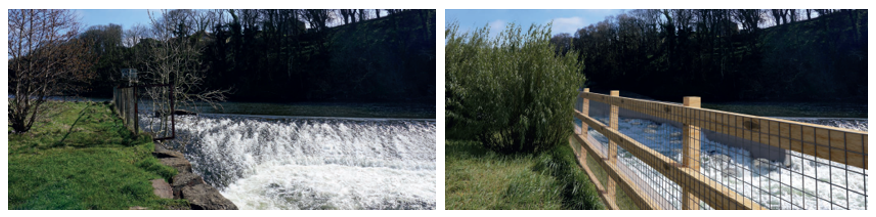
Yearl Weir before (left) and after our work (right)